For US Healthcare Professionals Only

For US Healthcare Professionals Only
EFFICACY

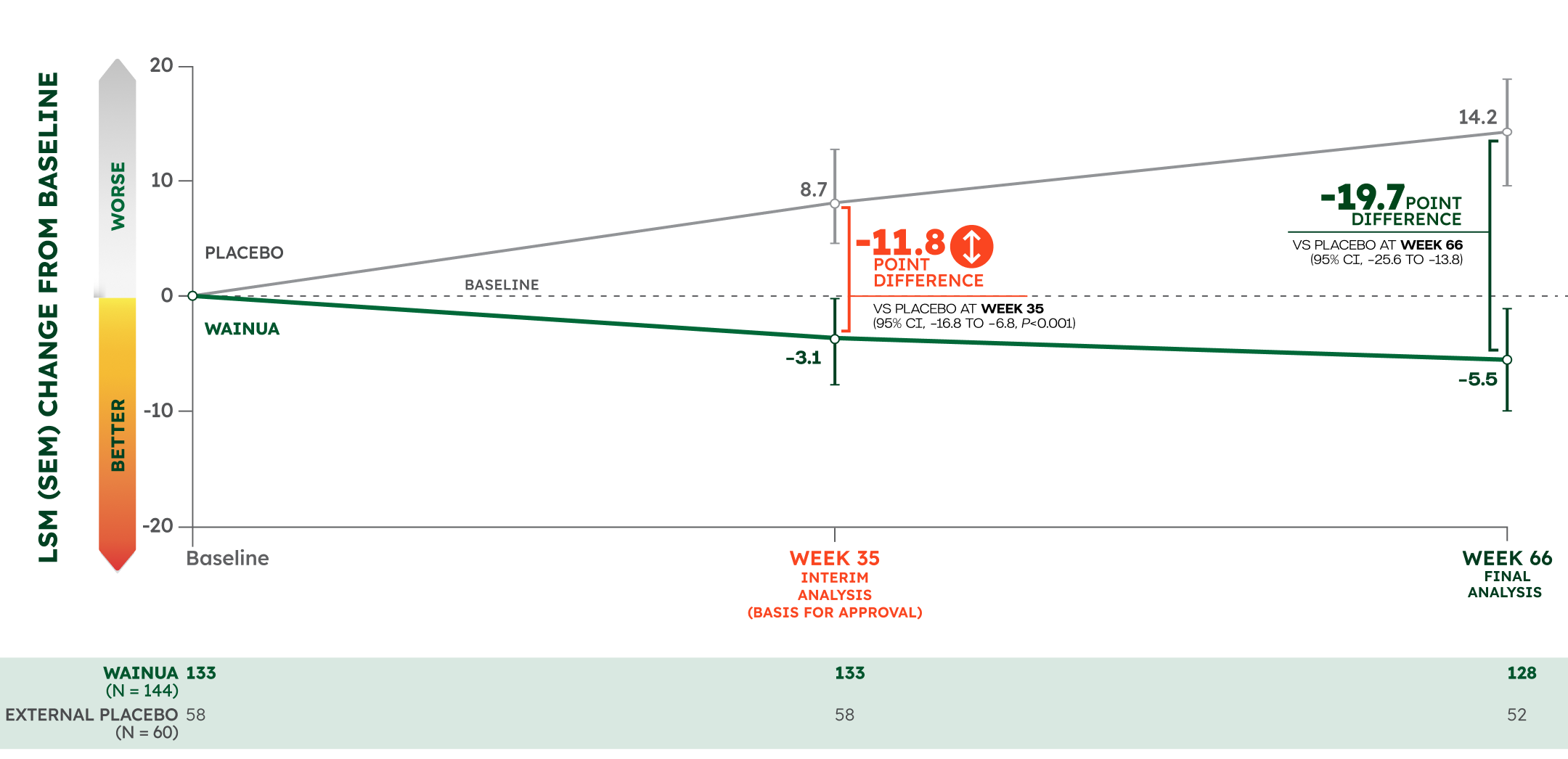
Assessed by the mNIS+7 composite score, which measured motor, sensory, and autonomic function1,3
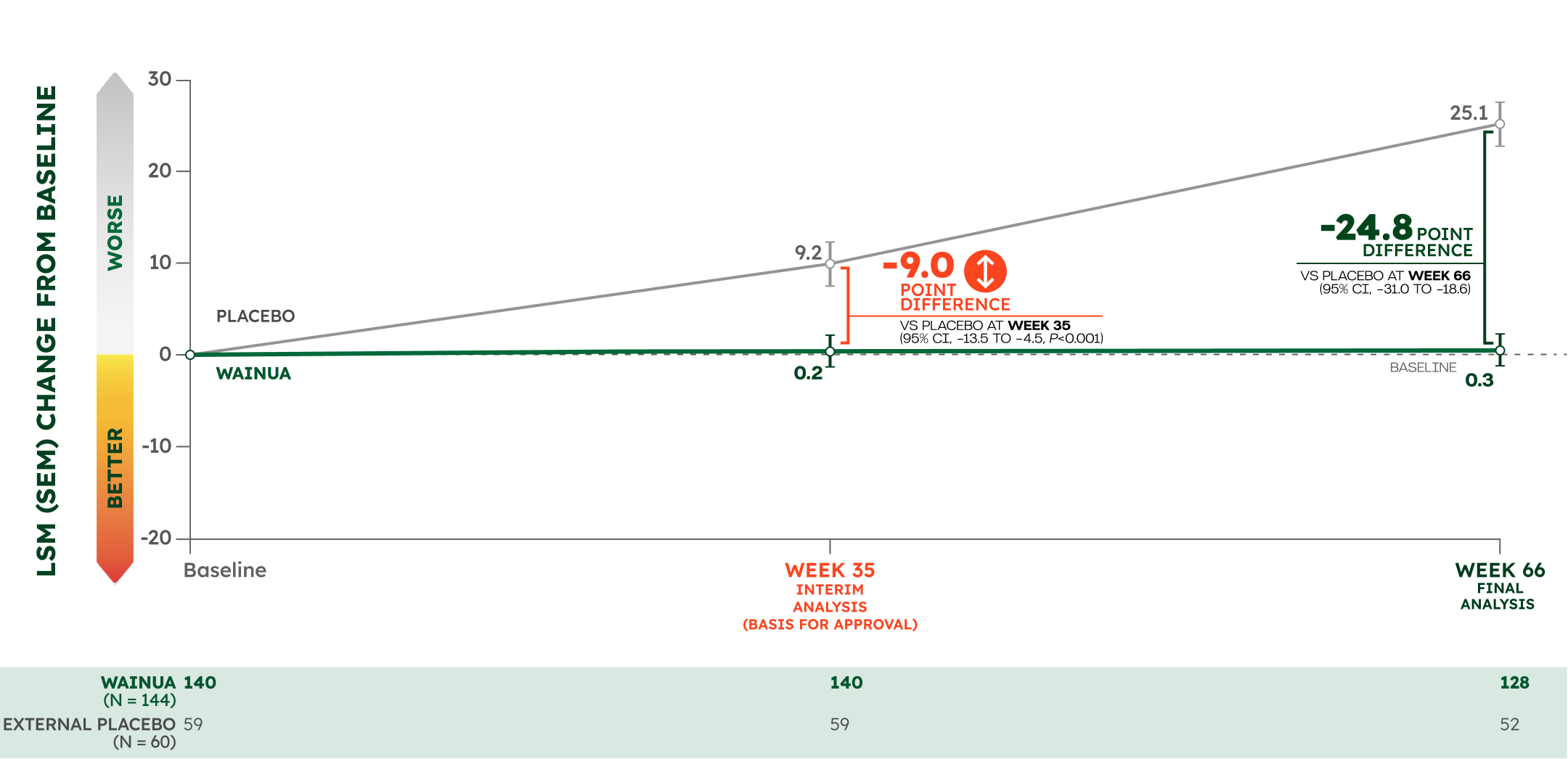
NEURO-TTRansform was a Phase 3, randomized, open-label trial. Data presented from baseline to Week 35 are from the interim analysis; data beyond Week 35 are from the final analysis. Because the primary and key secondary endpoints were statistically significant at Week 35, no further formal statistical analyses were performed at Week 65/66. See study design.1-4
Exploratory analysis
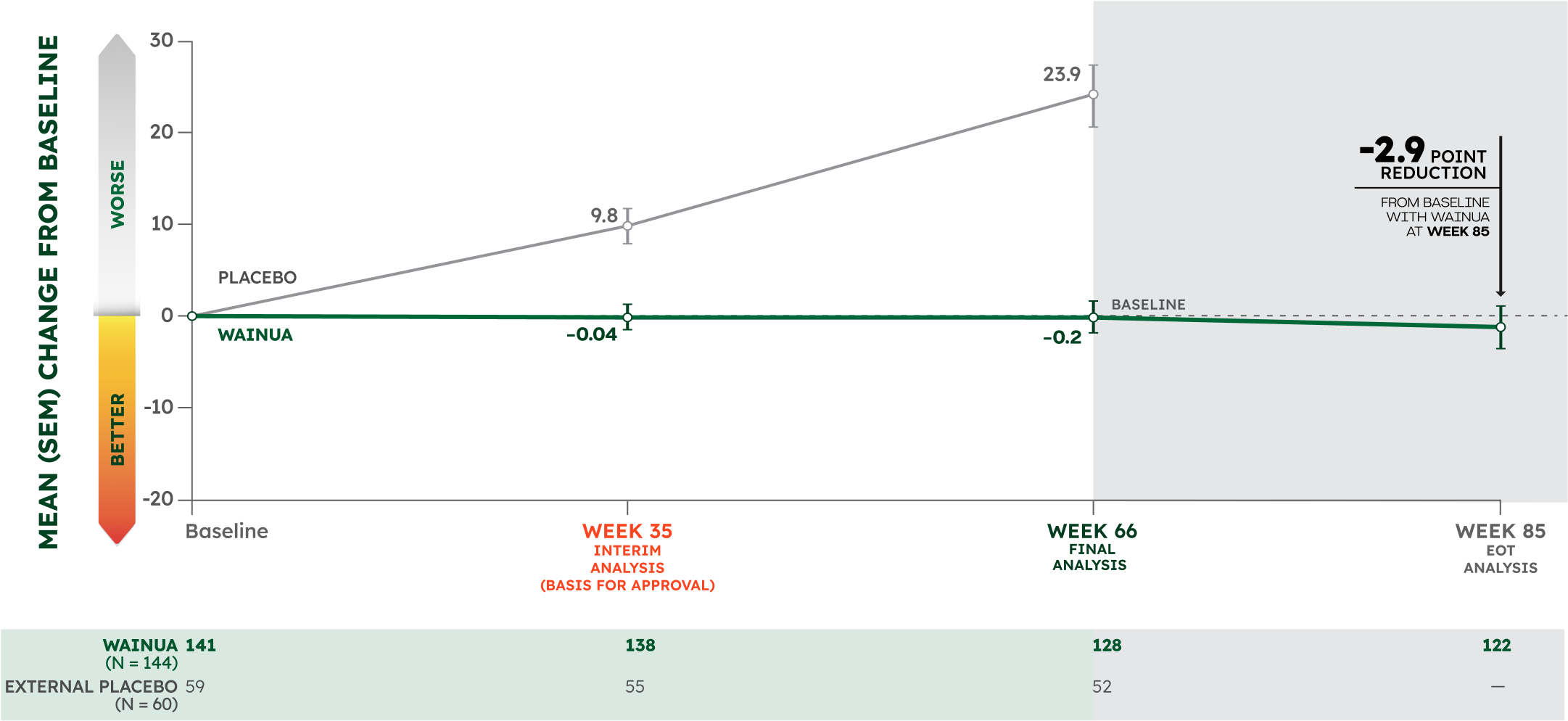
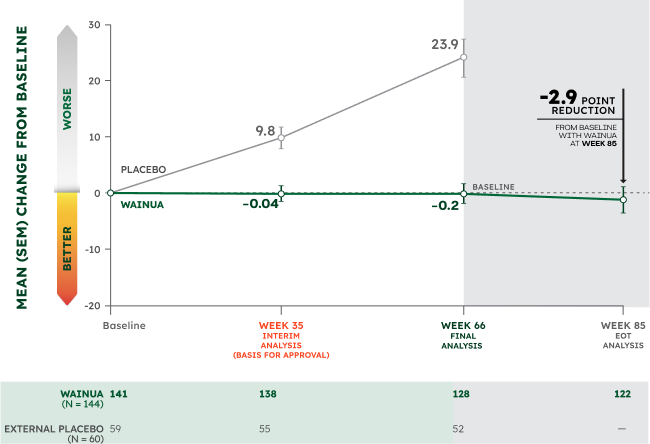
Note: From Week 66 to Week 85, there was no external placebo group because NEURO-TTR concluded at Week 66. Change in mNIS+7 composite score was assessed as an exploratory outcome at Week 85. No formal statistical analyses were performed at Week 85.3
Scores measure muscle strength/weakness, quantitative sensory testing, sensations, reflexes, nerve conduction, and heart rate response to deep breathing.


Assessed in 24 muscle groups
Assessed in up to 10 sites
Assessed touch, pressure, and pinprick
Assessed in 5 muscle groups
5 nerve assessments
*As measured by mNIS+7 composite score, a validated score in hATTR-PN to quantify neurologic impairment and progression.1,3,5
†The validated version of the mNIS+7 score used in the trial had a range of -22.3 to 346.3 points, with higher scores representing a greater severity of disease.1
‡Improvement is defined as a negative change from baseline; patients with missing data were counted as not improved.3
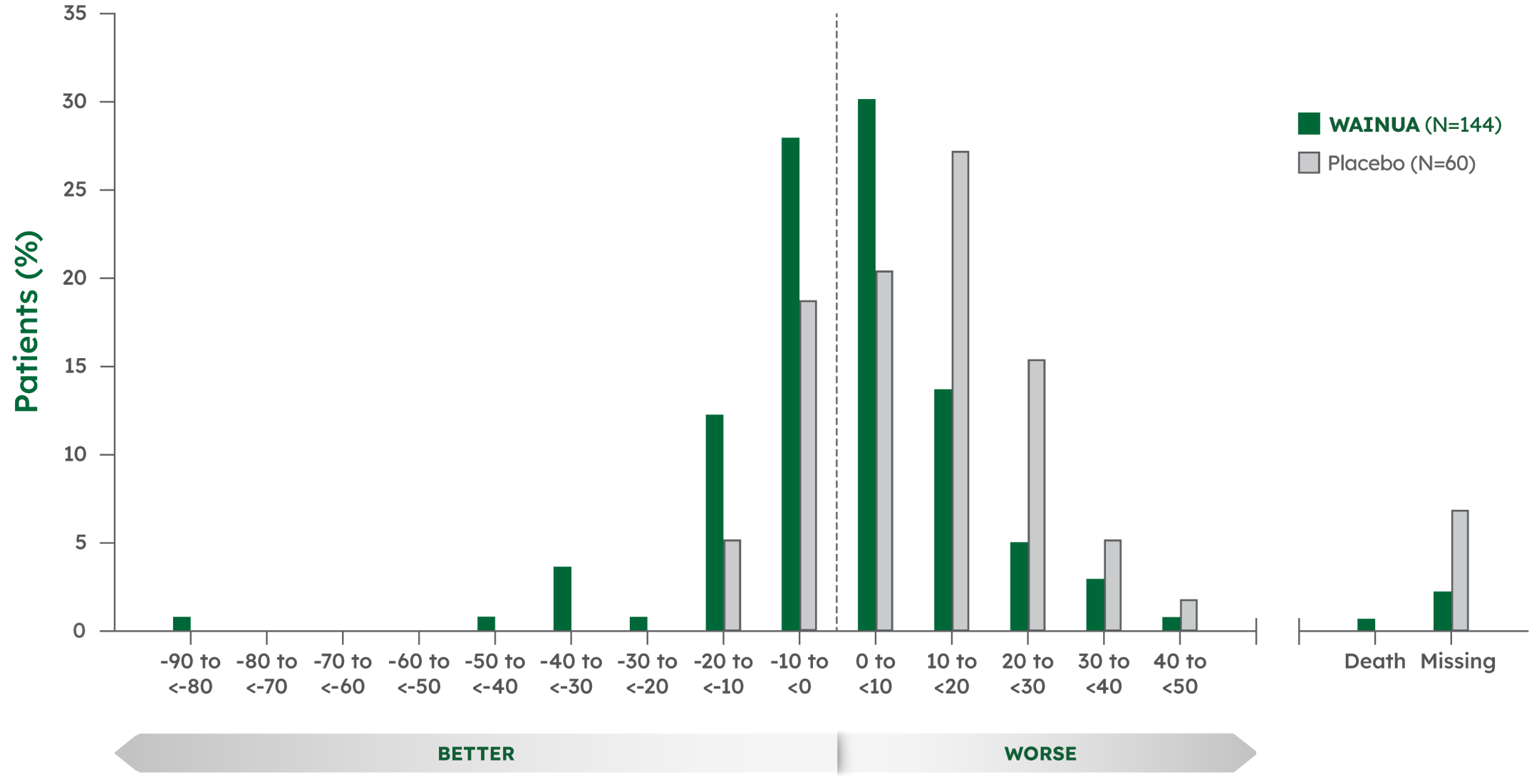
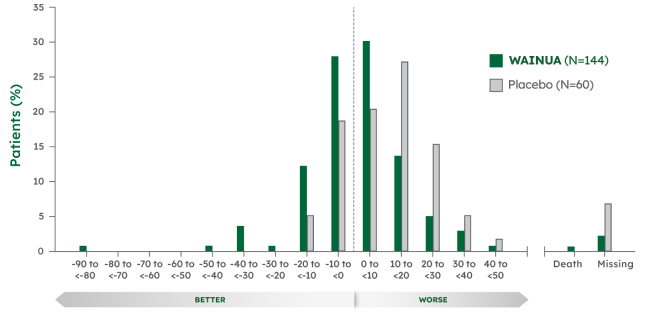
Patients treated with WAINUA had better mNIS+7 composite scores vs patients treated with placebo from baseline at Week 35 and Week 66.§2,3
Note: A responder (improvement) was defined as a patient whose mNIS+7 composite score change from baseline was less than threshold value of 0.2,3
§At Week 35, the number of patients in each group of the full analysis set was used as the denominator (WAINUA, N=140; placebo, N=59).2,3
At Week 66, the number of patients with nonmissing values in each group of the full analysis set was used as the denominator (WAINUA, N=128; placebo, N=52).2,3
NIS composite score is a component of the mNIS+7 composite score and measures muscle weakness, sensation, and reflexes. It does not include autonomic nervous system assessments (heart rate with deep breathing), nerve conduction studies (NCS), or quantitative sensory testing (QST).||5,6
NIS data from Week 162 interim analysis of NEURO-TTRansform extension study was measured from treatment initiation in the index study.6
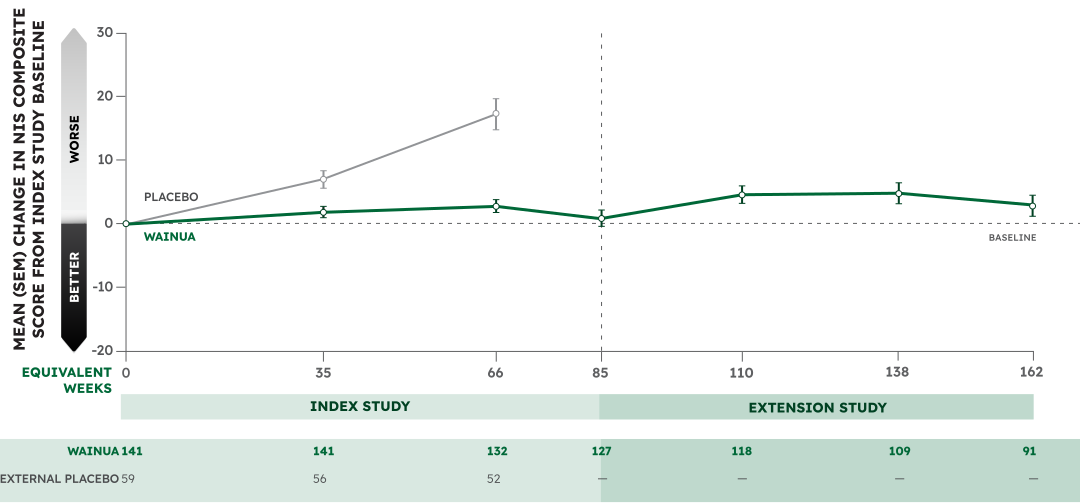
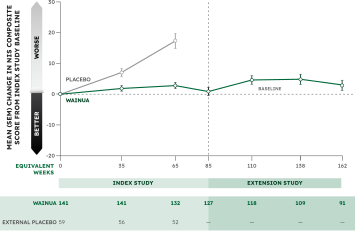
Note: The placebo group refers to the external placebo control arm from the NEURO-TTR trial. From Week 66 to Week 162, there was no external placebo group because the NEURO-TTR trial concluded at Week 66. No formal statistical analyses were performed.6,7
mNIS+7 was a co-primary endpoint in the NEURO-TTRansform index study, but only NIS, a component of the mNIS+7 composite score, was collected in the extension study. NIS data was extracted from mNIS+7 in NEURO-TTRansform (WAINUA) and NEURO-TTR (external placebo).1,6,7
The NEURO-TTRansform extension is an ongoing, Phase 3, open-label study evaluating the long-term efficacy and safety of WAINUA in patients who completed the NEURO-TTRansform index study. The interim analysis includes only patients randomized to receive WAINUA in the index study and excludes patients from the inotersen switch group. The demographics and clinical characteristics at baseline were generally similar between the index and extension cohorts. See study design.6
||NIS composite score is a component of the mNIS+7 composite score and is graded on a scale of 0 to 244, with higher scores representing greater severity of disease. Autonomic function is excluded from the components evaluated by NIS.5
As measured by the Norfolk QoL-DN score, which measured domains including symptoms, daily activities, and physical function1
NEURO-TTRansform was a Phase 3, randomized, open-label trial. Data presented from baseline to Week 35 are from the interim analysis; data beyond Week 35 are from the final analysis. Because the primary and key secondary endpoints were statistically significant at Week 35, no further formal statistical analyses were performed at Week 65/66. See study design.1-4
Exploratory analysis
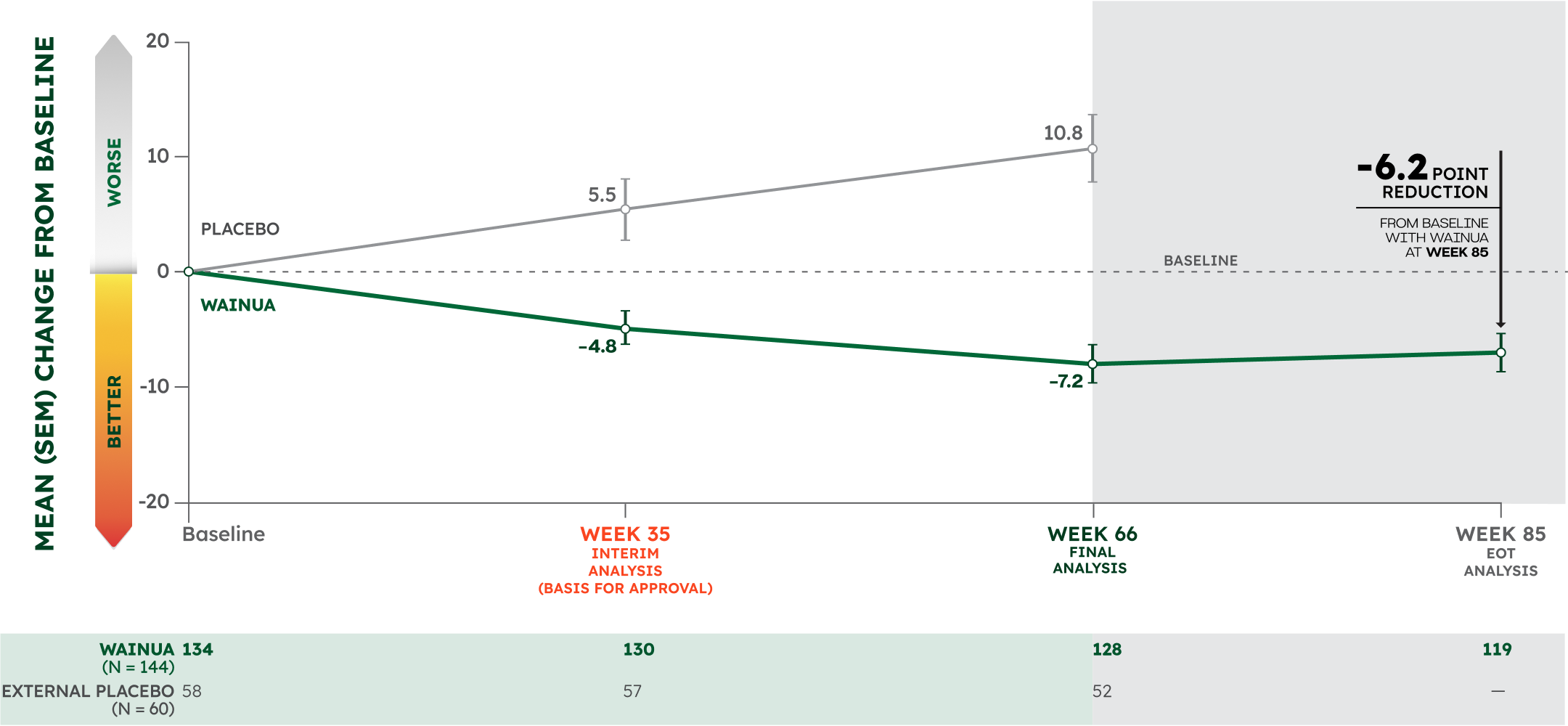
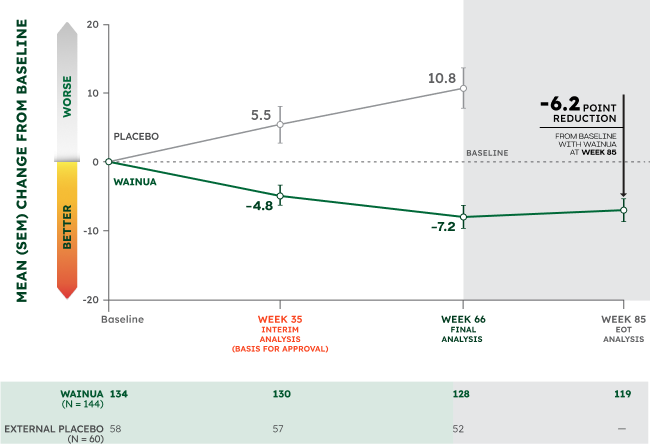
Note: From Week 66 to Week 85, there was no external placebo group because NEURO-TTR concluded at Week 66. Change in Norfolk QoL-DN total score was assessed as an exploratory outcome at Week 85. No formal statistical analyses were performed at Week 85.3
Scores measure 5 domains, including physical function/large-fiber neuropathy, activities of daily living, symptoms, small-fiber neuropathy, and autonomic nerve function.1
Neuropathy-related impact, including orthostasis, gastrointestinal, and genitourinary functions
Impact of motor functions and sensory function related to large-nerve fibers (eg, weakness, unsteadiness on feet, unable to feel feet when walking)
Impact of neuropathy on routine activities of daily life (eg, bathing, toileting, and fine finger movements)
Impact of the common symptoms of neuropathy at 4 body sites (feet, legs, hands, and arms)
Impact of sensory function related to small-fibers (eg, numbness, tingling, needle-like pain, and loss of thermal sensation)
¶As measured by Norfolk QoL-DN total score, a validated patient-reported quality-of-life assessment for patients with hATTR-PN.1,8,9
#Improvement is defined as a negative change from baseline; patients with missing data were counted as not improved.3
**The version of the Norfolk QoL-DN that was used in the trial had a range from -4 to 136 points, with higher scores representing greater impairment.1
††Norfolk QoL-DN was a key secondary endpoint at Week 35 and a co-primary endpoint at Week 66.1,3,4
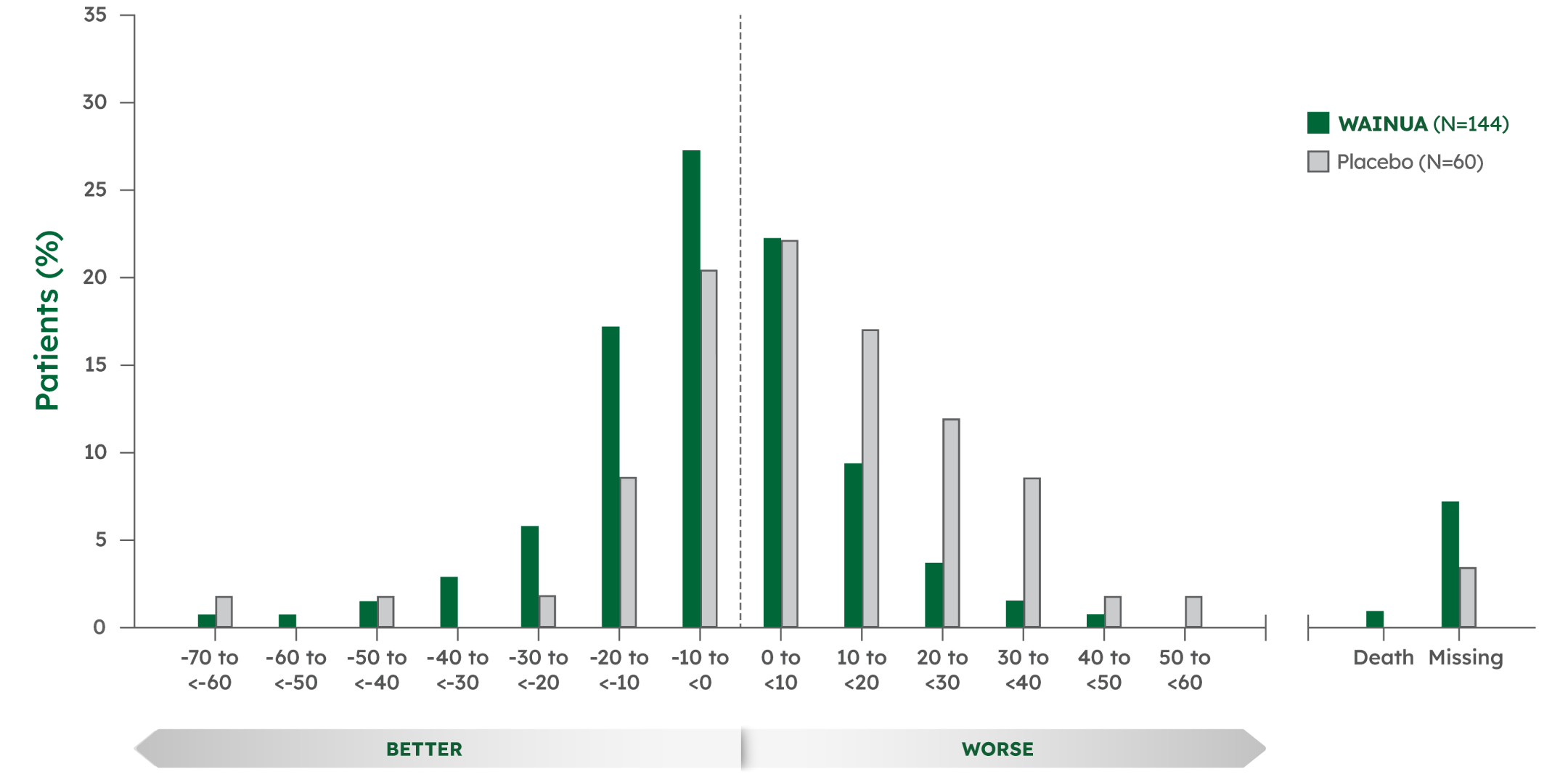
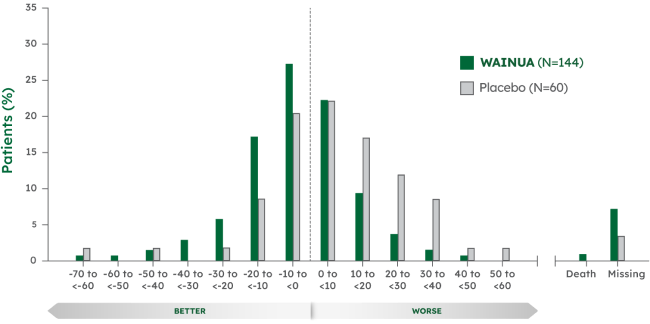
Patients treated with WAINUA had better Norfolk QoL-DN total scores vs patients treated with placebo from baseline at Week 35 and Week 66.‡‡2,3
Note: A responder (improvement) was defined as a patient whose Norfolk QoL-DN score change from baseline was less than threshold value of 0.2,3
‡‡At Week 35, the number of patients in each group of the full analysis set was used as the denominator (WAINUA, N=140; placebo, N=59).2,3
At Week 66, the number of patients with nonmissing values in each group of the full analysis set was used as the denominator (WAINUA, N=128; placebo, N=52).2,3
Norfolk QoL-DN includes measures for physical functioning, symptoms score, and activities of daily living.1
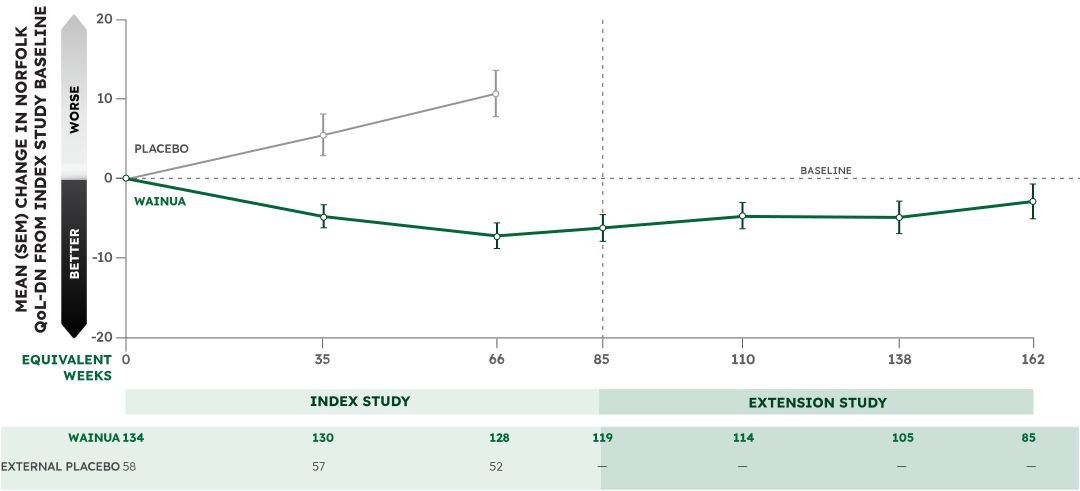
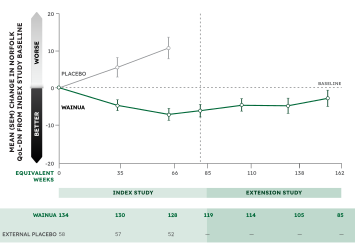
Note: The placebo group refers to the external placebo control arm from the NEURO-TTR trial. From Week 66 to Week 162, there was no external placebo group because the NEURO-TTR trial concluded at Week 66. No formal statistical analyses were performed.6,7
The NEURO-TTRansform extension is an ongoing, Phase 3, open-label study evaluating the long-term efficacy and safety of WAINUA in patients who completed the NEURO-TTRansform index study. The interim analysis includes only patients randomized to receive WAINUA in the index study and excludes patients from the inotersen switch group. The demographics and clinical characteristics at baseline were generally similar between the index and extension cohorts. See study design.6
EOT, end of treatment; hATTR-PN, polyneuropathy of hereditary transthyretin-mediated amyloidosis; LSM, least-squares mean; mNIS+7, modified Neuropathy Impairment Score +7; NIS, Neuropathy Impairment Score; Norfolk QoL-DN, Norfolk Quality of Life-Diabetic Neuropathy; QoL, quality of life; SEM, standard error of mean.
WARNINGS AND PRECAUTIONS
ADVERSE REACTIONS
Most common adverse reactions (≥9% in WAINUA-treated patients) were vitamin A decreased (15%) and vomiting (9%).
INDICATION
WAINUA injection, for subcutaneous use, 45 mg is indicated for the treatment of the polyneuropathy of hereditary transthyretin-mediated amyloidosis in adults.
Please see the full Prescribing Information.
You may report side effects related to AstraZeneca products.