For US Healthcare Professionals Only

For US Healthcare Professionals Only
STUDY DESIGN

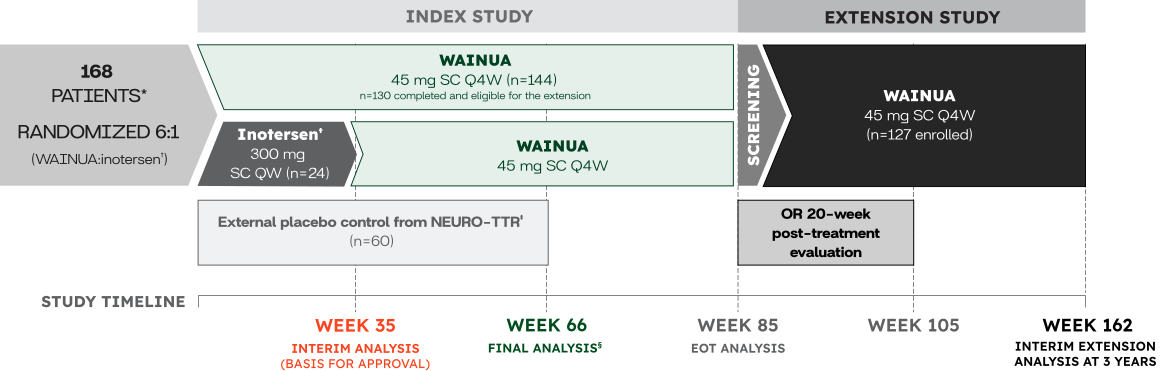
All patients received supplemental doses of the recommended daily allowance of vitamin A.
The external placebo control from NEURO-TTR was appropriate because of similar eligibility criteria and endpoints1,3,6
*Patients included in NEURO-TTRansform were 18 to 82 years of age, and had a confirmed diagnosis of hATTR-PN as defined by all of the following: Stage 1 (ambulatory without assistance) or Stage 2 (ambulatory with assistance) familial amyloid polyneuropathy or Coutinho stage; documented mutation of the TTR gene; and signs and symptoms consistent with hATTR-PN, including NIS ≥10 and ≤130. Patients must have discontinued active treatment with any other approved drug for hATTR 2 weeks prior to study.2,3
†The inotersen reference group was intended to confirm sufficiently comparable disease progression and treatment response patterns between NEURO-TTR and NEURO-TTRansform trials.3
‡All endpoints were compared with the placebo arm of the earlier NEURO-TTR trial (NCT01737398).1,2,6
§The final analysis endpoints were distributed over 2 visits (Week 65 and Week 66), as prespecified in the protocol.3
Co-primary Endpoints:
SERUM TTR
% CHANGE FROM BASELINE vs PLACEBO AT WEEK 35
mNIS+7
CHANGE FROM BASELINE
vs PLACEBO AT WEEK 35
Key Secondary Endpoint:
NORFOLK QoL-DN
CHANGE FROM BASELINE vs PLACEBO AT WEEK 35
Co-primary Endpoints:
SERUM TTR
% CHANGE FROM BASELINE
vs PLACEBO AT WEEK 65
mNIS+7
CHANGE FROM BASELINE
vs PLACEBO AT WEEK 66
NORFOLK QoL-DN
CHANGE FROM BASELINE
vs PLACEBO AT WEEK 66
Key Secondary Endpoint:
mBMI
CHANGE FROM BASELINE
vs PLACEBO AT WEEK 65
Post Hoc Endpoint:
SERUM TTR
% CHANGE FROM
BASELINE AT WEEK 85
Exploratory Endpoints:
mNIS+7
CHANGE FROM BASELINE
AT WEEK 85
NORFOLK QoL-DN
CHANGE FROM BASELINE
AT WEEK 85
COMPASS-31
CHANGE FROM BASELINE
AT WEEK 81
Exploratory Endpoints:
SERUM TTR
MEAN % CHANGE FROM INDEX STUDY BASELINE
NIS
MEAN CHANGE FROM INDEX STUDY BASELINE
NORFOLK QoL-DN
MEAN CHANGE FROM INDEX STUDY BASELINE
mBMI
MEAN (SEM) CHANGE IN mBMI FROM INDEX STUDY BASELINE
COMPASS-31, Composite Autonomic Symptom Score-31; EOT, end of treatment; hATTR, hereditary transthyretin-mediated amyloidosis; hATTR-PN, polyneuropathy of hereditary transthyretin-mediated amyloidosis; mBMI, modified body mass index; mNIS+7, modified Neuropathy Impairment Score +7; NIS, Neuropathy Impairment Score; Norfolk QoL-DN, Norfolk Quality of Life-Diabetic Neuropathy; Q4W, every 4 weeks; QW, every week; SC, subcutaneous; TTR, transthyretin.
WARNINGS AND PRECAUTIONS
ADVERSE REACTIONS
Most common adverse reactions (≥9% in WAINUA-treated patients) were vitamin A decreased (15%) and vomiting (9%).
INDICATION
WAINUA injection, for subcutaneous use, 45 mg is indicated for the treatment of the polyneuropathy of hereditary transthyretin-mediated amyloidosis in adults.
Please see the full Prescribing Information.
You may report side effects related to AstraZeneca products.